











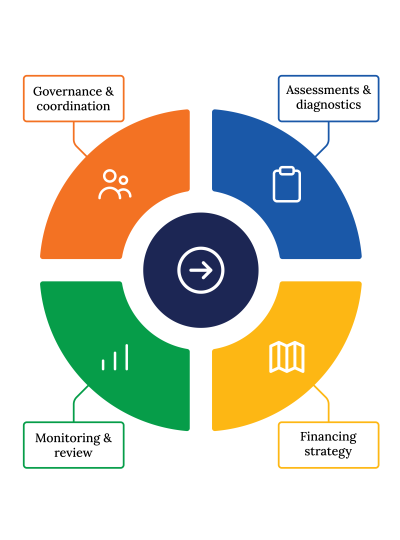



Financial services for small traders and cooperatives
Financial services for small traders and cooperatives
Type 3: Borderland with fragile context and underdeveloped regional integration infrastructure.
Business Model Description
Deploy agent-based and mobile banking solutions tailored to informal traders and cooperatives. Partner with SACCOs and fintech providers to offer flexible credit, working capital loans, and savings products. Target cross-border traders, market vendors, and aggregation cooperatives. Blend commercial capital with concessional financing and guarantee schemes to de-risk lending and expand outreach.
How is this information gathered?
Cross-border investment opportunities with potential to contribute to sustainable development are based on Borderlands SDG Investor Maps.
Disclaimer
UNDP, the Private Finance for the SDGs, and their affiliates (collectively “UNDP”) do not seek or solicit investment for programmes, projects, or opportunities described on this site (collectively “Programmes”) or any other Programmes, and nothing on this page should constitute a solicitation for investment. The actors listed on this site are not partners of UNDP, and their inclusion should not be construed as an endorsement or recommendation by UNDP for any relationship or investment.
The descriptions on this page are provided for informational purposes only. Only companies and enterprises that appear under the case study tab have been validated and vetted through UNDP programmes such as the Growth Stage Impact Ventures (GSIV), Business Call to Action (BCtA), or through other UN agencies. Even then, under no circumstances should their appearance on this website be construed as an endorsement for any relationship or investment. UNDP assumes no liability for investment losses directly or indirectly resulting from recommendations made, implied, or inferred by its research. Likewise, UNDP assumes no claim to investment gains directly or indirectly resulting from trading profits, investment management, or advisory fees obtained by following investment recommendations made, implied, or inferred by its research.
Investment involves risk, and all investments should be made with the supervision of a professional investment manager or advisor. The materials on the website are not an offer to sell or a solicitation of an offer to buy any investment, security, or commodity, nor shall any security be offered or sold to any person, in any jurisdiction in which such offer would be unlawful under the securities laws of such jurisdiction.
Region
Sector Classification
Financials
Corporate and Retail Banking
Borderland development need
Small traders, farmers, and cooperatives across the borderland operate largely outside the formal financial system, relying on home savings, VSLAs, or high-cost informal lenders. As of 2016/17, 27% of households in Karamoja could not save with any financial institution, and only 28% owned a mobile phone. Despite vibrant local trade and entrepreneurial activity—over 40% of households report having an enterprise—access to affordable credit and banking services remains a key constraint. This stifles productivity, weakens resilience, and limits business growth, particularly for youth- and women-led enterprises. (1, 2)
Borderland policy priority
Both Karamoja's KIDP3 and West Pokot's CIDP emphasize financial inclusion, enterprise development, and strengthening cooperatives. They identify tailored credit as key to unlocking inclusive growth and supporting local enterprise participation in trade and value chains. Nationally, Kenya Vision 2030 emphasizes inclusive finance, mobile banking, and cooperative development. Similarly, Uganda’s National Financial Inclusion Strategy (2017–2022) aims to reduce financial exclusion through support to SACCOs, mobile financial services, and low-cost savings and credit products tailored to underserved populations. These priorities converge on enabling accessible, affordable finance for rural enterprise growth and resilience. (1, 2, 18, 19, 20)
Gender inequalities and marginalization issues
Exclusion is often reinforced by collateral requirements, rigid KYC procedures, and products that do not reflect the needs or behaviors of underserved groups. Women and youth—especially those engaged in small-scale cross-border trade or informal enterprises—struggle to access loans, open accounts, or build credit histories. Expanding agent networks, mobile-based savings and credit products, and alternative credit scoring models are key to unlocking financial access and building pathways toward economic inclusion for these groups. (16, 17)
Investment opportunities introduction
High-potential investments include SACCO capitalisation, mobile and agent banking expansion, cross-border credit products, and tailored SME financing. Digital financial services targeting cooperatives, women-led businesses, and youth entrepreneurs can fill existing gaps in savings, lending, and payment services. (12, 14, 15)
Key bottlenecks introduction
Major barriers include high interest rates, long processing times, stringent collateral requirements, and underdeveloped digital infrastructure. Banks perceive the region as high-risk and under-served: there are only four commercial banks on each side of the borderland, and around 1.4 mobile agent for 1,000 people. Limited financial literacy and low mobile phone ownership further constrain uptake of available products and services. (12, 13, 14, 19)
Consumer Finance
Pipeline Opportunity
Financial services for small traders and cooperatives
Deploy agent-based and mobile banking solutions tailored to informal traders and cooperatives. Partner with SACCOs and fintech providers to offer flexible credit, working capital loans, and savings products. Target cross-border traders, market vendors, and aggregation cooperatives. Blend commercial capital with concessional financing and guarantee schemes to de-risk lending and expand outreach.
Business Case
Market Size and Environment
< USD 50 million
Borderland markets host hundreds of informal traders and over 100 cooperatives lacking access to formal finance. High demand exists for micro-loans, mobile savings, and group credit under $2,000. This creates a large, underserved market with frequent, low-value transactions and strong potential for financial services tailored to rural enterprises. (30)
Indicative Return
> 25%
Agent-based and mobile banking models offer 20–35% ROI due to low operating costs, high repayment rates, and strong demand for flexible credit. Benchmarks from fintechs like M-Shwari and MoKash show 25–40% ROI at scale. With tailored loan terms and group lending mechanisms, financial services can be both profitable and inclusive. (30)
Investment Timeframe
Short Term (0–5 years)
Returns can materialize within 2–3 years. Year 1 focuses on onboarding SACCOs, training agents, and piloting mobile products. Year 2 expands reach and revenue from transaction fees and interest margins. By Year 3, operational breakeven is expected, aligning with regional benchmarks in rural digital finance. (30)
Ticket Size
< USD 500,000
Market Risks and Scale Obstacles
Capital - Requires Subsidy
Business - Supply Chain Constraints
Market - Highly Regulated
Expected Financing Model
Blended financing (risk sharing and public support)
IOA Business Criteria
Strong unmet demand among small traders and cooperatives; viability supported by fintech uptake, SACCO networks, and donor-backed de-risking facilities. (22, 23, 24)
Targets informal traders and cooperatives using agent networks, SACCO-fintech partnerships, and flexible digital lending products. (22, 23, 24)
High replication potential via mobile platforms, regional SACCO linkages, and cross-border financial ecosystems. (22, 23, 24)
Similar models like M-Shwari, MSC Uganda, and Equity Bank RSF show success with agent-led, small-scale finance in rural areas. (22, 23, 24)
Impact Case
Sustainable Development Need
Many traders and cooperatives in Karamoja and West Pokot rely on informal savings or costly lenders, limiting business growth, asset accumulation, and resilience to shocks. (1, 2, 12, 14)
Over 40% of households in Karamoja lack any form of formal savings, with limited access to mobile banking, SACCOs, or affordable credit. (7, 9, 12, 18)
Many SACCOs and trader groups lack working capital and credit facilities, impeding aggregation, storage, and access to regional markets. (26, 27)
Gender & Marginalisation
Women face greater exclusion due to lack of collateral, mobility constraints, and low financial literacy, limiting access to credit and savings. (16, 17)
Many young people, especially in Karamoja, store money at home due to limited mobile access and exclusion from formal financial services. (24)
Women and youth are underrepresented in cooperative leadership, reducing their influence over financial decision-making and benefit sharing. (22)
Expected Development Outcome
Expanding mobile and SACCO-based services enables informal traders and cooperatives to access credit and savings, unlocking livelihoods and reducing poverty. (12, 14, 22)
Flexible working capital allows small businesses to grow, improving incomes and creating employment, especially for youth and women. (23)
By increasing financial resilience and cross-border market participation, the provision of tailored financial services addresses exclusion and resource-based tensions that fuel insecurity. (25, 26, 27)
Gender & Marginalisation
Tailored loan products and SACCO partnerships enable women-led businesses to access credit, build assets, and grow income-generating activities. (16, 17)
Mobile and agent-based solutions reduce access barriers for youth, fostering self-employment and financial independence. (22)
Group-based lending and literacy training help marginalized groups overcome collateral and knowledge barriers, promoting equitable economic participation. (14)
Primary SDGs addressed
1.1.1 Proportion of the population living below the international poverty line by sex, age, employment status and geographic location (urban/rural)
In 2020, the poverty rate was 66% in Karamoja and 57% in West Pokot. (1, 2)
The government of Uganda aims to reduce the incidence of poverty in Karamoja to 42.2% over the next five-year period. (1)
8.10.2 Proportion of adults (15 years and older) with an account at a bank or other financial institution or with a mobile-money-service provider
As of 2017, 82% of Kenyan adults aged 15 and above had an account at a financial institution or with a mobile-money-service provider. In Uganda, the figure was approximately 59.2% for the same demographic in 2017. (32, 33)
N/A
10.2.1 Proportion of people living below 50 per cent of median income, by sex, age and persons with disabilities
N/A
N/A
Secondary SDGs addressed
Directly impacted stakeholders
People
Gender inequality and/or marginalization
Planet
Corporates
Public sector
Indirectly impacted stakeholders
People
Gender inequality and/or marginalization
Planet
Corporates
Public sector
Outcome Risks
Over-indebtedness may occur if financial literacy is not strengthened, leading vulnerable traders to default and lose trust in formal finance.
Unequal access to credit may worsen marginalization if youth and women lack support to meet loan conditions or navigate digital tools.
Poorly targeted lending could inflame tensions if certain ethnic or cross-border groups feel excluded from financial services.
Increased digital financial activity without regulation may expose users to fraud, data misuse, or exploitative lending practices.
Impact Risks
Low financial literacy and distrust in formal systems may limit uptake, preventing people from accessing credit and savings that support livelihoods.
Poor infrastructure and digital gaps may hinder service delivery, leaving remote or mobile populations without consistent access.
Gender norms, low literacy, and mobility constraints may prevent women from fully benefiting, reinforcing exclusion from economic opportunities.
IMP Impact Classification
What
Improved access to affordable and tailored financial services enhances income security, supports small business growth, and strengthens local trade systems.
Who
Directly impacts informal traders, cooperatives, women and youth in Karamoja–West Pokot; indirectly supports broader community resilience.
Risk
Low digital literacy, weak SACCO capacity, and limited trust in formal finance may reduce adoption and impact.
Enabling Environment
General Policy Environment
Karamoja Integrated Development Plan 3 (KIDP3): Prioritizes financial inclusion through support to SACCOs, VSLAs, and training on savings and credit for farmers and traders, enabling uptake of tailored financial services. (1)
West Pokot County Integrated Development Plan (CIDP): Emphasizes strengthening cooperatives, promoting access to affordable credit for traders through the County Cooperative Development Fund and Biashara Mashinani. (2)
Kenya Fourth Medium Term Plan (MTP IV) 2023–2027: Focuses on expanding access to digital and inclusive finance, especially in underserved areas, encouraging innovation, and strengthening SACCOs and fintech partnerships. (34)
Uganda National Financial Inclusion Strategy (2017–2022): Aims to reduce financial exclusion through digital solutions, SACCO development, and insurance, with specific provisions for youth and rural entrepreneurs. (20)
Kenya Vision 2030 – Economic Pillar: Recognizes the financial sector as a key enabler of inclusive growth and trade, advocating for deeper financial access and cooperative strengthening in marginalized regions. (18)
General Cross-border Trade Policy and Regulatory environment
EAC Cross-Border Trade in Services Protocol (2010): Promotes regional integration and facilitates the free movement of services, including banking and mobile finance, enabling fintech and SACCOs to operate across borders.
EAC Payment and Settlement Systems Integration Project (PSSIP): Aims to harmonize digital financial infrastructure across member states, supporting mobile banking and cross-border remittances critical to informal traders.
EAC Financial Sector Development and Regionalization Strategy (2016–2025): Encourages financial inclusion, regional SACCO integration, and regulatory alignment, all vital to scaling community-based finance in border areas.
IGAD Protocol on Transhumance (2021): While livestock-focused, it provides a framework for cooperation in cross-border livelihoods, reinforcing the case for coordinated financial services targeting mobile traders and cooperatives.
Capital structure and funding
Sources of Capital: Most capital comes from national SACCOs, donor-backed microfinance, and international blended finance. Development partners like IFC, UNCDF, and World Bank support inclusive finance with risk-sharing or concessional credit lines. (23, 24, 25)
Average Capital Size: Existing pilots range from $100K to $500K, used to expand agent networks or seed lending capital. Identified opportunities may require $250K–$750K to integrate SACCO-fintech partnerships and scale across districts. (22, 24, 30)
Trends of Capital Flows: Funding to the financial sector has grown, but most capital remains concentrated in urban centers. SACCOs and MFIs in Karamoja and West Pokot remain undercapitalized despite rising demand for trader and cooperative loans. (23, 24, 25)
Impact of Conflict on Capital Flows: Insecurity deters private lenders and limits physical access to banking services. (1, 2)
Development Partner Support: Support focuses on financial inclusion, women’s access to finance, and SME development. Projects like GROW and FSD Uganda fund SACCO capacity-building, digital platforms, and credit guarantee schemes targeting underserved markets. (23, 24)
Financial incentives
Agricultural Credit Facility (Uganda): The ACF, managed by the Bank of Uganda, provides low-interest loans to SACCOs, cooperatives, and agribusinesses, making it suitable for working capital loans in underserved regions like Karamoja. (44)
Microfinance Support Centre (MSC): MSC offers micro and group loans to SACCOs and cooperatives at subsidized rates (~8%), paired with capacity-building. It targets youth, women, and agriculture, and is active in Karamoja. (24)
GROW Project (Uganda): Funded by the World Bank, GROW offers concessional loans to women entrepreneurs via commercial banks at interest rates as low as 9.2%. It targets sectors like small trade and processing. (24)
Biashara Mashinani Fund (West Pokot): This county-level fund offers affordable credit to small traders and cooperatives. It aims to strengthen local business capacity and expand access to finance for underserved groups. (1)
Security Environment
Recurrent cattle raiding incidents incidents create unsafe market environments and disrupt trade routes, deterring financial institutions from setting up agent networks and increasing transaction risks for mobile and cooperative-based banking. (4, 45, 46)
Small traders and aggregation cooperatives face ambushes along major routes (e.g. Moroto–Kotido and Kacheliba–Amudat). This reduces confidence in market travel, weakens loan repayment cycles, and discourages cooperative-led aggregation. (4, 45, 46)
Weak state presence fuels reliance on informal justice, which can create business uncertainty and legal insecurity for borrowers, lenders, and SACCOs attempting to recover loans or resolve disputes. (4, 45, 46)
Clashes between ethnic groups periodically close border points, halting trade. For cross-border financial services models, this undermines continuity of operations, especially for cooperatives straddling both sides. (45, 46, 48)
Risk mitigation strategies
Ensure fair representation of women and marginalized groups on cooperative boards and loan committees to reduce elite capture, enhance trust, and align products with diverse user needs.
Support government dialogue under EAC and IGAD frameworks to align licensing, digital KYC norms, and cross-border loan recovery rules, enabling SACCO and fintech models to operate across the border.
Integrate conflict analysis and peacebuilding into loan targeting by coordinating with local peace committees and designing repayment terms that factor in seasonal mobility and market disruptions.
Combine grants and concessional capital with risk-sharing facilities (e.g., guarantees) to crowd in private banks and fintechs, reducing hesitation to lend in underserved or insecure areas.
Partner with trusted local actors to deliver training in local languages on group savings, responsible borrowing, and digital finance, building resilience against shocks and predatory lenders.
Actors in IOA Space
References
Sector and Subsector Sources
- (1) Ministry for Karamoja Affairs & Office of the Prime Minister. (2021). The Third Karamoja Integrated Development Plan (KIDP 3) 2021–2025.
- (2) County Government of West Pokot. (2023). Third County Integrated Development Plan (CIDP) 2023–2027.
- (3) Catley, A., et al. (2021). Introducing pathways to resilience in the Karamoja Cluster. Pastoralism, 11(28). https://doi.org/10.1186/s13570-021-00214-4
- (4) UNDP Africa Borderlands Centre. (2022). The Karamoja Cluster: Rapid Conflict Analysis and Gender Assessment (Kenya and Uganda).
- (5) Kenya High Commission Kampala. (2025). Kenya-Uganda Trade & Investments. Accessed February 2025. https://www.kenyamissionkampala.ug/kenya-uganda-trade-investments
- (6) Columbia SIPA. (2020). Ethical Cross-Border Trading between Kenya and Uganda by Women-led Micro and Small Enterprises.
- (7) Aklilu, Y. (2017). Livestock Trade in Karamoja, Uganda: An Update of Market Dynamics and Trends. USAID. https://karamojaresilience.org/wp-content/uploads/2021/05/tufts_1803_krsu_livestock_trade_karamoja_v2_online.pdf
- (8) Arasio, R.L., and E. Stites. 2022. “The Return of Conflict in Karamoja, Uganda: Community Perspectives.” Karamoja Resilience Support Unit (KRSU), Feinstein International Center, Friedman School of Nutrition Science and Policy at Tufts University, Kamp
- (9) Interpeace, IGAD, & FAO. (2023). Conflict, Climate Change, Food Security and Mobility in the Karamoja Cluster. https://www.interpeace.org/wp-content/uploads/2024/01/Conflict-climate-change-food-security-and-mobility-in-the-Karamoja-Cluster.pdf
- (10) Armed Conflict Location & Event Data Project (ACLED). (2025). Regional Overview – Africa, February 2025. https://acleddata.com/2025/02/10/africa-overview-february-2025 "11) Central Bank of Kenya (CBK), Kenya National Bureau of Statistics (KNBS), and FSD Kenya. (2021). 2021 FinAccess Household Survey. Nairobi. "
- (12) Mwaniki, J. M., & Nyanga’au, C. N. (2023). Impact of Financial Inclusion on Access to Finance for Startup and Business Operations in Arid and Semi-Arid Lands of Kenya. KIPPRA Discussion Paper No. 307. Retrieved from: https://kippra.or.ke/download/impact-of-financial-inclusion-on-access-to-finance-for-startup-and-business-operations-in-arid-and-semi-arid-lands-of-kenya-dp-307 "13) CBK, KNBS, & FSD Kenya. (2022). FinAccess Household Survey: County Perspective. Nairobi. Retrieved from: https://www.fsdkenya.org/wp-content/uploads/2022/11/FinAccess-Household-Survey-County-perspective-November-2022-2.pdf "
- (14) Financial Inclusion Tracker Surveys Project. (2012). Mobile Money in Uganda: Use, Barriers and Opportunities. Retrieved from: https://www.findevgateway.org/sites/default/files/publications/files/mfg-en-paper-mobile-money-in-uganda-use-barriers-and-opportunities-oct-2012.pdf
- (15) Budget Monitoring and Accountability Unit (BMAU). (2014). Microfinance Support Centre’s provision of Institutional loans: Why is uptake declining? BMAU Briefing Paper (10/14). Retrieved from: https://archive.finance.go.ug/sites/default/files/Publications/BMAU%20Briefing%20Paper%2010-14%20-Microfinance%20Support%20Centre%E2%80%99s%20provision%20of%20Institutional%20loans.%20Why%20is%20uptake%20declining.pdf
- (16) FSD Uganda. (2021). Gender Barriers to Access and Use of Financial Services by Women in Uganda. Kampala. Retrieved from: https://www.fsduganda.or.ug/wp-content/uploads/2022/01/Gender-Qualitative-Study-Report-November-2021.pdf
- (17) International Finance Corporation (IFC). (2020). Research and Literature Review of Challenges to Women Accessing Digital Financial Services. Washington, D.C._site/gender+at+ifc/resources/dfs-literature-review
- (18) Government of the Republic of Kenya. (2007). Kenya Vision 2030: A Globally Competitive and Prosperous Kenya. Nairobi: Ministry of Planning and National Development. Retrieved from: https://vision2030.go.ke/publication/kenya-vision-2030-popular-version
- (19) CBK, CMA, IRA, RBA, & SASRA. (2023). Kenya Financial Sector Stability Report 2023. Nairobi. Retrieved from: https://www.centralbank.go.ke/uploads/financial_sector_stability/388563208_FSR%202023_published.pdf
- (20) Government of the Republic of Uganda. (2017). National Financial Inclusion Strategy 2017–2022. Kampala: Ministry of Finance, Planning and Economic Development. Retrieved from: https://ugandabankers.org/wp-content/uploads/2024/01/National-Financial-Inclusion-Strategy-2017-2022.pdf
IOA Sources
- (21) Interview with public district officers in Moroto and West Pokot
- (22) Interview with Foundation supporting access to finance for entrepreneurs in West Pokot
- (23) Interviews with main commercial banks in Moroto
- (24) Interviews with microfinance institutions in Karamoja and West Pokot
- (25) Interviews with SACCO managers in Moroto
- (26) Interview with the Moroto livestock market committee
- (27) Interview with the Moroto Livestock Traders and Butchery Association
- (28) Interview with an agribusiness consultant for a large international organisation
- (29) Interview with West Pokot Chamber of Commerce
- (30) Estimations based on interview data with district officers, commercial banks, microfinance institutions, SACCOs, and regional studies.
- (31) Interview with milk cooperatives in West Pokot
- (32) World Bank. (2022). The Global Findex Database 2021: Financial Inclusion, Digital Payments, and Resilience in the Age of COVID-19. Washington, DC: World Bank. Retrieved from: https://www.worldbank.org/en/publication/globalfindex/Data
- (33) CEIC Data. (n.d.). Uganda Bank Account Ownership: % of Population Aged 15–24. Retrieved from: https://www.ceicdata.com/en/uganda/bank-account-ownership/ug-bank-account-ownership-at-a-financial-institution-or-with-a-mobilemoneyservice-provider--of-population-aged-1524
- (34) Republic of Kenya. (2024). Fourth Medium Term Plan (MTP IV) 2023–2027: Popular Version. Nairobi: Kenya Vision 2030 Delivery Secretariat. Retrieved from: https://vision2030.go.ke/wp-content/uploads/2024/03/FINAL-MTP-IV-2023-2027-Popular-Version_240320_184300.pdf
- (35) Government of Kenya. (2006). The Microfinance Act, 2006. Nairobi: National Council for Law Reporting.
- (36) Republic of Uganda. (2016). Tier 4 Microfinance Institutions and Moneylenders Act, 2016. Kampala: Government of Uganda.
- (37) Republic of Kenya. (2008). The SACCO Societies Act No. 14 of 2008. Nairobi: National Council for Law Reporting.
- (38) Republic of Uganda. (2020). The Cooperative Societies (Amendment) Act, 2020. Kampala: Government of Uganda.
- (39) Central Bank of Kenya. (2010). Guideline on Agent Banking. Nairobi: Central Bank of Kenya.
- (40) East African Community (EAC). (2010). Protocol on the Establishment of the EAC Common Market – Annex on Trade in Services. Arusha: EAC Secretariat.
- (41) East African Community (EAC). (n.d.). Payment and Settlement Systems Integration Project (PSSIP). Arusha: EAC Secretariat.
- (42) EAC. (2016). EAC Financial Sector Development and Regionalization Strategy (FSDRP) 2016–2025. Arusha: EAC Secretariat.
- (43) IGAD. (2021). Protocol on Transhumance in the IGAD Region. Djibouti: Intergovernmental Authority on Development (IGAD).
- (44) Bank of Uganda. (n.d.). Agricultural Credit Facility (ACF). Kampala: Bank of Uganda.
- (45) Gray, S., Sundal, M., Wiebusch, B., Little, M. A., Leslie, P. W., & Pike, I. L. (2003). “Cattle Raiding, Cultural Survival, and Adaptability of East African Pastoralists”. Current Anthropology, 44(S5), S3–S30. Retrieved from: https://www.journals.uchicago.edu/doi/full/10.1086/377669
- (46) Stites, E. (2022). Conflict in Karamoja: A Synthesis of Historical and Current Perspectives, 1920–2022. Karamoja Resilience Support Unit (KRSU), Feinstein International Center, Tufts University.
- (47) USAID. (2023). Applied Political Economy Analysis for the Karamoja Cluster. Washington, DC: USAID.
- (48) Interview with cross-border trade associations.